

The “Sich” interactive shooting range is a training complex designed for teaching accurate marksmanship and tactical actions in a simulated environment. The system integrates hardware components, a projection screen, specialized software, and a wide range of training weapon replicas, from pistols and assault rifles to machine guns and mounted grenade launchers.
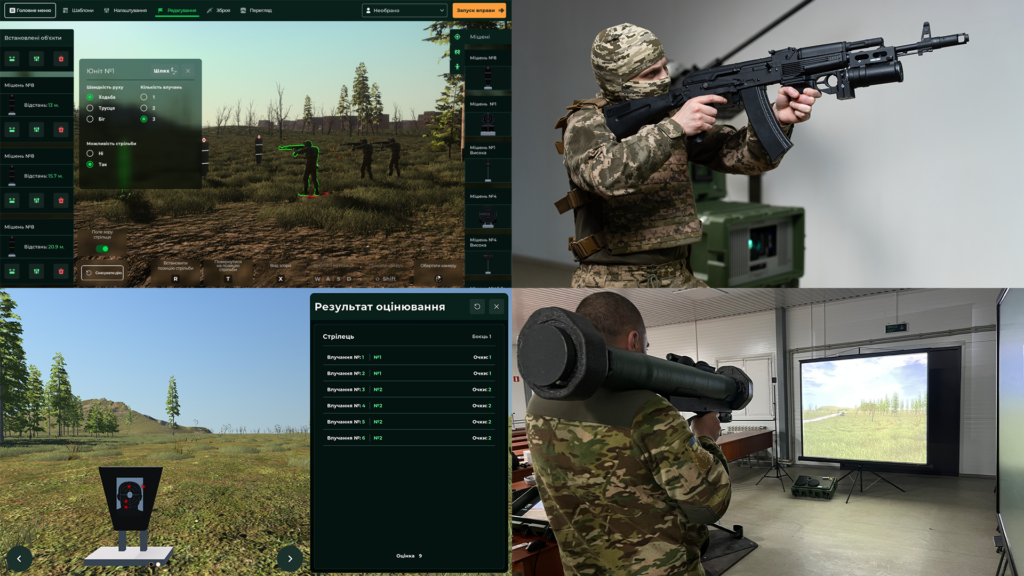
The complex allows instructors to modify weather conditions, engagement distances, target types, combat scenarios, and environmental settings. An instructor can monitor training in real time and analyze a service member’s performance after each exercise.
Unlike traditional multimedia shooting ranges, which primarily focus on marksmanship alone, the “Sich” system is designed for comprehensive soldier training — from correct firing stance and movement between shooting positions to the use of cover and decision-making under pressure.
Two-Sided Fire Engagement
Новий модуль двостороннього вогневого контакту додає до тренування елемент зворотної реакції системи на дії військовослужбовця.
During the exercise, the soldier uses a helmet equipped with a sensor that tracks their position in space. A separate tracking sensor determines whether the service member is in cover or exposed to simulated engagement.
Modular cover is used for training, allowing personnel to practice firing from protected positions, switching firing sectors, and moving in and out of cover.
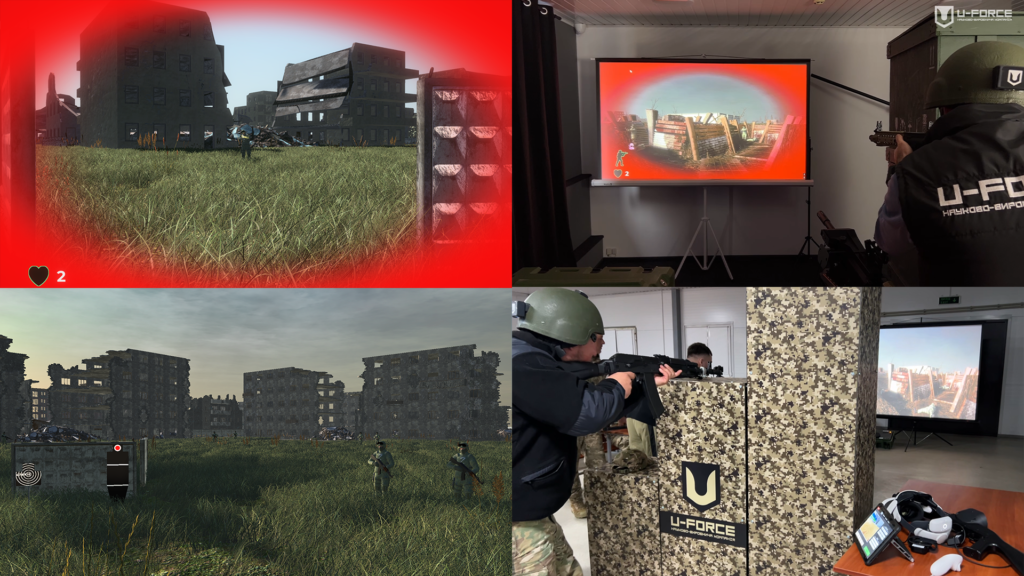
If the soldier correctly uses cover, the system prevents them from being “engaged” in simulation. However, in the event of errors, improper movement, or remaining in an exposed position for too long, the interactive units may simulate the soldier being wounded or neutralized.
In such cases, a wrist-worn shock bracelet is activated, delivering a controlled impulse that increases psychological pressure and enhances training realism.
According to the company, the primary objective of the system is to develop correct reflexes and behavioral patterns in service members during contact with an opposing force.
According to the developers, one of the key challenges in training newly arrived service members is adapting to stress and developing fundamental skills for operating under the threat of being engaged.
In real conditions, even correct execution of marksmanship drills does not guarantee effectiveness if a soldier is unable to properly use cover, rapidly change positions, control sectors, or operate under psychological pressure.
That is why the two-sided fire engagement system makes training more dynamic and closer to real combat conditions.
U-FORCE LLC also emphasizes that the system can be used both for basic training and for the regular maintenance of skills within military units.
The use of an interactive shooting range significantly reduces expenses on ammunition and the organization of individual training stages, while also ensuring training can be conducted regularly regardless of weather conditions or access to training ranges.
At the same time, service members gain the ability to repeatedly run scenarios, analyze their own mistakes, and develop actions to the point of automation.
U-FORCE LLC notes that the development of such training systems is one of the key directions for improving the quality of personnel preparation in the conditions of modern warfare, where reaction speed, proper use of cover, and stress resilience directly affect a soldier’s chances of survival.


